
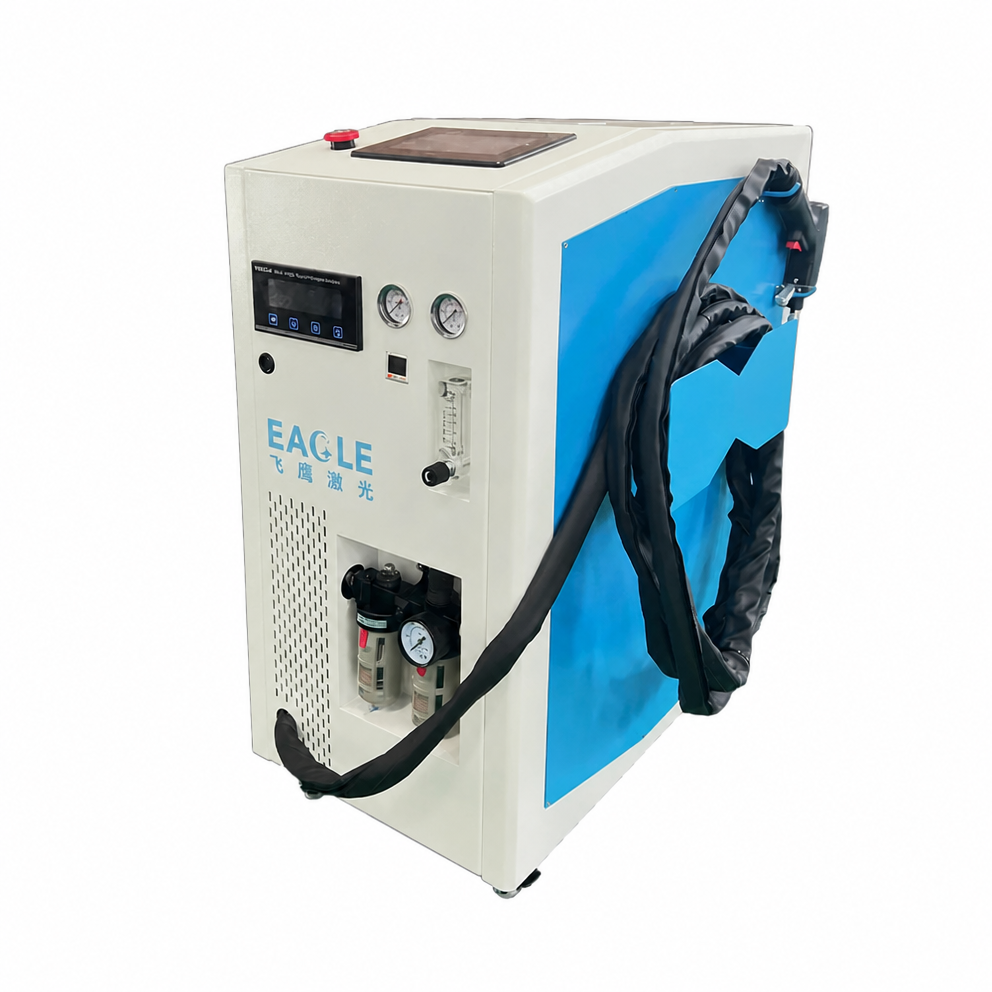
Three "Hidden Costs" of Traditional Welding Workshops
① Heavy labor dependence and runaway costs: Welders require long‑term training yet suffer high turnover rates, trapping enterprises in a vicious cycle of difficult recruitment and even harder staff retention.
② Inconsistent quality and high rework rates: Affected by fatigue and mood, human operators cannot precisely control heat input, which leads to heavy workpiece deformation and frequent porosity. Post‑weld grinding and straightening often account for half of total working hours.
③ Low efficiency for complex trajectories: Manual operations face great difficulties with 3D spatial curves or micro‑gaps, and fail to meet high‑speed mass‑production demands in sectors such as new‑energy and aerospace.
Breakthrough Solutions of Laser‑Automated Workstations for Three Core Scenarios
① Scenario 1: Mass Production of Hardware and Auto‑Parts Structural Components
‑ Pain points: Conventional tooling fixtures deliver slow positioning, manual welding features long cycle times, and thick‑plate splicing is prone to undercutting and incomplete fusion.
‑ Eagle Laser Solution: Deploy robotic laser welding workstations. Combined with high‑precision positioners and gantry structures, the key‑hole effect of laser deep‑penetration welding enables single‑pass large‑depth welding.
‑ Field‑proven results: After adopting this solution, an automotive components manufacturer achieved a 3‑5‑fold increase in welding speed. The heat‑affected zone is reduced to the micrometer level with nearly zero workpiece deformation. Cumbersome post‑weld straightening procedures are eliminated, and overall manufacturing costs drop by 40%.
② Scenario 2: Hermetic Sealing Welding for New‑Energy Precision Cavities
‑ Pain points: Precision parts including battery modules and liquid‑cooled plates require extremely strict air‑tightness performance. Uneven heat input during manual welding easily causes burn‑through or internal porosity.
‑ Eagle Laser Solution: Custom‑built automated laser welding production lines. CNC systems precisely regulate defocus distance, pulse waveform and shielding‑gas flow. Supported by on‑line monitoring technology, real‑time closed‑loop correction is performed for molten‑pool status.
‑ Field‑proven results: The weld depth‑to‑width ratio remains stably above 5:1, porosity rate is kept below 0.5%, and product yield reaches 99.5%, easily passing rigorous air‑tightness tests.
③ Scenario 3: Small‑batch & Multi‑variant Non‑standard Customization
‑ Pain points: Time‑consuming teaching and programming for traditional robots lead to high change‑over costs, which cannot fit the flexible‑manufacturing trend of multiple product varieties and small‑batch sizes.
‑ Eagle Laser Solution: Adopt cutting‑edge vision seam‑locating and AI‑trained manipulator technologies. Cumbersome teaching is no longer required. The system automatically identifies weld trajectories and adaptively adjusts process parameters.
‑ Field‑proven results: Change‑over time is shortened from hours to minutes, realizing flexible automation for direct processing of incoming workpieces. It enables small‑ and medium‑sized enterprises to achieve lights‑out factory capabilities.
Eagle Laser: Redefining Automation Boundaries Through Industry‑University‑Research Expertise
As a high‑tech enterprise located in the Optoelectronics & Intelligent Manufacturing Industrial Park of Changchun New District, Eagle Laser supplies not only standalone equipment but also turn‑key projects for automated production‑line transformation:
- In‑depth industry‑university‑research integration: Drawing on research strengths from Changchun Institute of Optics, Fine Mechanics and Physics, Chinese Academy of Sciences and Huazhong University of Science and Technology, the company has overcome technical challenges including welding of high‑reflectivity materials and anti‑electromagnetic interference, ensuring outstanding stability of automated lines under complex working conditions.
- Blueprint for “Laser + Automation + AI”: The company proactively develops industrial robotic welding products, deeply coupling AI vision with laser‑welding processes to endow equipment with self‑learning and self‑optimization capabilities.
- Core‑component collaboration: In‑depth cooperation with leading industrial‑chain partners such as Yongli Laser guarantees high electro‑optical conversion efficiency and long service life of laser sources, lowering customers’ overall operation and maintenance costs at the source.
Bid Farewell to Labor Shortage Pressures and Advance Smart‑Manufacturing Upgrades!
Is your workshop troubled by low welding efficiency and recruitment difficulties? Manufacturing enterprises of all types are welcome to make inquiries. Eagle Laser provides one‑stop solutions covering process testing and full automated‑system transformation.
Free Sample Testing · Try‑before‑buy | Custom‑tailored Exclusive Solutions
About Eagle Laser
Changchun Eagle Laser Equipment Co., Ltd. is situated in Changchun, birthplace of China’s first laser. It is a high‑tech enterprise within the Optoelectronics & Intelligent Manufacturing Industrial Park of Changchun New District. Leveraging local optoelectronic industry resources and research‑institute strengths for industry‑university‑research collaboration, the company focuses on R&D and manufacturing of laser welding, cutting, marking, cleaning and automated equipment. It holds 2 invention patents, plus more than 20 utility‑model patents and software copyrights. Its products serve automotive manufacturing, precision machinery, new‑energy and other industries and are sold worldwide.